

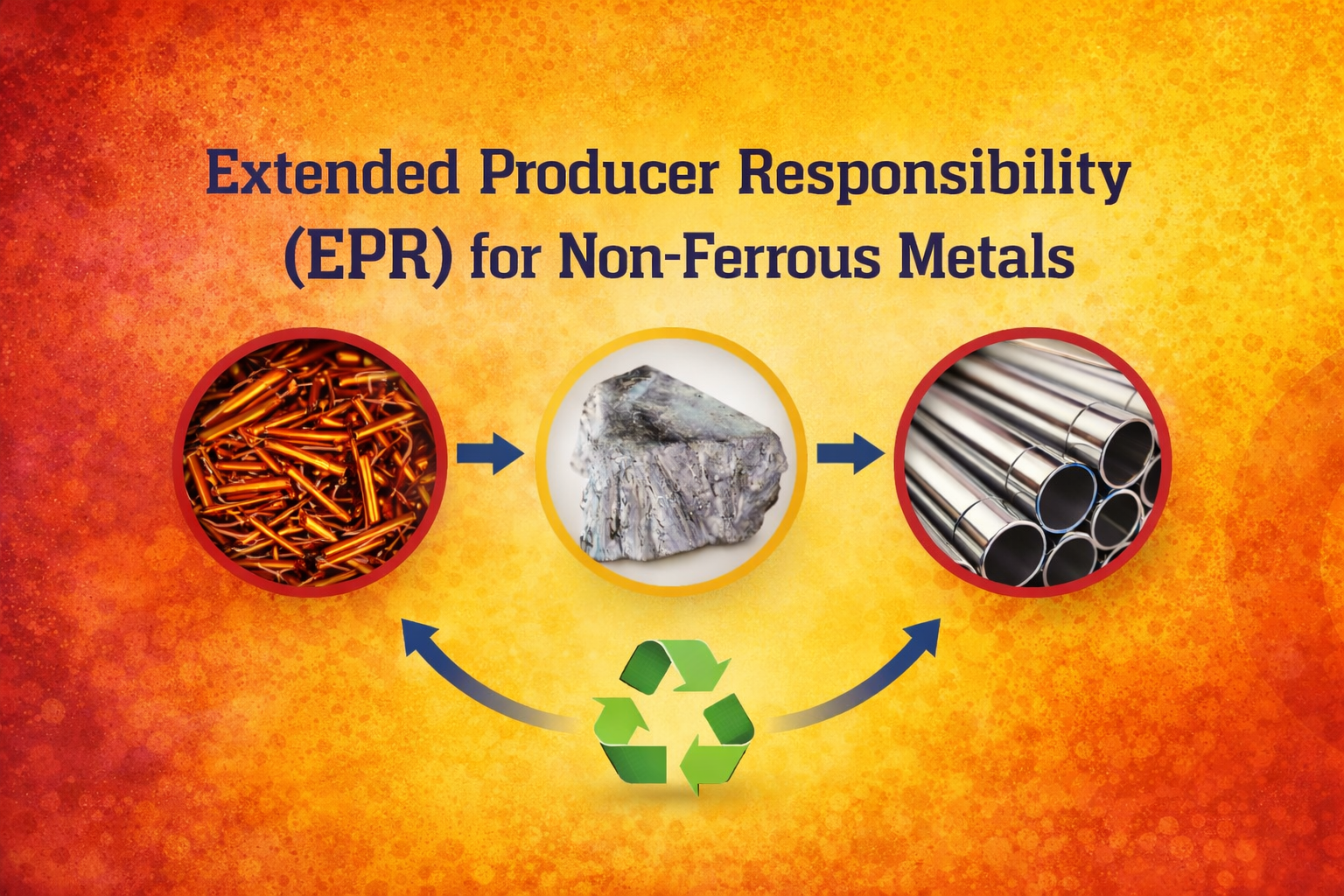
What is Non-Ferrous Metals Extended Producer Responsibility (EPR) Framework?
By Team Metacorp
Legal & Compliance Experts
Introduction: A Structural Reform in India’s Metal Governance
The Ministry of Environment, Forest and Climate Change (MoEF&CC), through the Hazardous and Other Wastes (Management and Transboundary Movement) Amendment Rules, 2025, has introduced a landmark regulatory architecture for non-ferrous metals, namely aluminum, copper, zinc and their alloys. This amendment formally integrates these metals into a statutory Extended Producer Responsibility (EPR) regime, marking a decisive shift from conventional waste regulation to a life-cycle–based governance model.
Unlike earlier frameworks that focused primarily on hazardous waste containment, the 2025 Amendment embeds principles of resource efficiency, circular economy, and shared environmental responsibility. The Rules shall come into force from 1 April 2026, allowing industry a defined transition period to realign compliance systems.
1. Regulatory Scope and Product Coverage
Metals Covered under metal EPR
The regulatory framework applies uniformly to the following non-ferrous metals:
- Aluminum
- Copper
- Zinc
- Their respective alloys
These metals occupy a position of strategic importance within the industrial and manufacturing ecosystem. Aluminum is widely used in construction, transportation, packaging, and electrical applications due to its lightweight, corrosion resistance, and strength-to-weight ratio. Copper is indispensable in electrical, electronics, and renewable energy sectors owing to its superior conductivity and durability. Zinc, primarily used for galvanization and alloying, plays a critical role in corrosion protection and infrastructure longevity.
From a regulatory perspective, these metals warrant focused oversight because they are highly recyclable, allowing significant conservation of natural resources, and their primary production processes are energy-intensive, with substantial environmental and carbon footprints. By covering both primary metals and their alloys, the framework ensures comprehensive regulation across the entire value chain, including extraction, refining, recycling, manufacturing, and downstream industrial use. This holistic approach promotes resource efficiency, environmental sustainability, and responsible industrial growth.
2. Introduction of Extended Producer Responsibility (EPR)
2.1. Conceptual Foundation
- Extended Producer Responsibility (EPR) is founded on the principle that producers who introduce products into the market must assume responsibility not only for their manufacture and sale, but also for their post-consumer and end-of-life management. The concept shifts the regulatory focus from waste disposal by public authorities to upstream accountability, requiring market participants to internalize the environmental costs associated with their products.
- Through this amendment, non-ferrous metals such as aluminum, copper, zinc, and their alloys are formally integrated into the EPR framework, placing them on par with regulated waste streams such as plastics and electronic waste under Indian environmental law. This alignment reflects global best practices and recognizes the significant environmental and energy implications associated with metal extraction, pcessing, and disposal.
- By extending EPR to non-ferrous metals, the regulatory regime seeks to encourage systematic collection, recycling, and recovery, reduce dependence on energy-intensive primary production, and promote a circular economy. The framework also reinforces the “polluter pays” principle, ensuring that producers, importers, and brand owners play an active role in minimizing environmental impact while fostering sustainable industrial growth.
2.2. Legal Obligations under EPR
Under the EPR framework, producers are subject to binding legal duties to ensure responsible end-of-life management of non-ferrous metal products. Key obligations include:
- Ensuring collection of end-of-life products
- Facilitating environmentally sound recycling through authorized entities
- Meeting prescribed annual recycling targets
- Maintaining transparent digital records on the CPCB portal
Importantly, ultimate compliance responsibility rests with the producer. Engagement of third-party collectors or recyclers does not absolve producers of liability, thereby reinforcing accountability across the value chain.
3. Mandatory Registration and Institutional Architecture
3.1 Entities Required to Register
The regulatory framework establishes mandatory registration as the cornerstone of institutional oversight and compliance. Accordingly, registration on the Central Pollution Control Board (CPCB) online portal is compulsory for all entities operating within the non-ferrous metal value chain, including:
- Manufacturers
- Producers, encompassing brand owners and importers
- Collection agents involved in take-back and aggregation activities
- Refurbishers engaged in extending product life cycles
- Recyclers undertaking processing and material recovery
This centralized registration mechanism enables regulatory authorities to ensure traceability, transparency, and coordinated monitoring across the sector. Importantly, the Rules expressly prohibit operations without valid registration, as well as commercial dealings with unregistered entities. Such prohibitions are designed to eliminate informal and non-compliant practices, strengthen regulatory enforcement, and ensure that environmental responsibilities are discharged only through authorized and accountable participants.
3.2 Centralized Digital Governance
The CPCB online portal operates as a single-window digital compliance system, forming the backbone of governance under the Rules. It integrates multiple regulatory functions on a unified platform, enabling:
- Online registration and categorization of all regulated entities
- Filing of half-yearly and annual returns in a standardized digital format
- Generation, trading, and adjustment of EPR certificates, facilitating market-based compliance
- Regulatory monitoring, verification, and audit by competent authorities
This digitised governance architecture substantially strengthens transparency, accountability, and real-time traceability across the non-ferrous metal recycling ecosystem. By replacing fragmented, paper-based processes with centralized digital oversight, the framework improves regulatory efficiency, minimizes compliance gaps, and supports evidence-based enforcement of Extended Producer Responsibility obligations.
4. Recycling Targets and Phased Compliance
4.1 Progressive Recycling Obligations
The recycling targets prescribed under Schedule XI adopt a phased and progressively escalating compliance model, designed to balance environmental objectives with industrial readiness. The prescribed targets are as follows:
- 10% during the initial compliance phase (2026–28)
- 30% during the mid-phase (2028–30)
- 50% during 2030–32
- 75% from 2032–33 onwards
This calibrated progression reflects regulatory pragmatism and policy foresight. By introducing lower thresholds in the initial years, the framework allows producers, recyclers, and other stakeholder’s adequate time to establish collection networks, invest in recycling infrastructure, and formalize partnerships. The gradual increase in targets ensures a smooth transition toward higher recovery rates, while steadily embedding circular economy principles into the non-ferrous metals sector without causing undue disruption to industrial operations.
4.2 Importers and Used Products
Importers of used products or non-ferrous metal scrap are subject to a 100% EPR obligation, underscoring the principle that imported waste must not burden domestic environmental systems.
5. EPR Credits
5.1 Generation of Certificates
Registered recyclers generate EPR certificates in proportion to their actual recycling output, ensuring that only verified recycling activities are credited. The quantity of certificates is calculated using CPCB-approved conversion factors, which account for the technology used and process efficiency.
By linking certificate generation to measurable recycling performance, the framework ensures credible, outcome-based compliance, while encouraging efficient technologies and strengthening the integrity of the EPR market mechanism.
5.2 Trading and Adjustment
Producers purchase EPR certificates to meet their recycling obligations, providing flexibility in compliance. Certificates are issued with defined validity periods, ensuring timely utilization.
The CPCB regulates minimum and maximum trading prices to prevent market distortion and ensure fairness. This market-based mechanism incentivizes formal recycling while discouraging environmentally unsound and informal practices.
6. Refurbishment as a Sustainability Tool
The Rules formally recognize refurbishment and life-extension as legitimate sustainability pathways. Key features include:
- Mandatory registration of refurbishes
- Issuance of refurbishment certificates
- Temporary deferment of EPR liability
Only 75% of deferred liability is reintroduced post extended use, thereby incentivizing durable product design and reuse.
7. Environmental Compensation and Enforcement
7.1 Penalties for Non-Compliance
Failure to comply attracts stringent consequences, including:
- Environmental compensation equivalent to damage caused
- Suspension or cancellation of CPCB registration
- Prosecution under the Environment (Protection) Act, 1986