

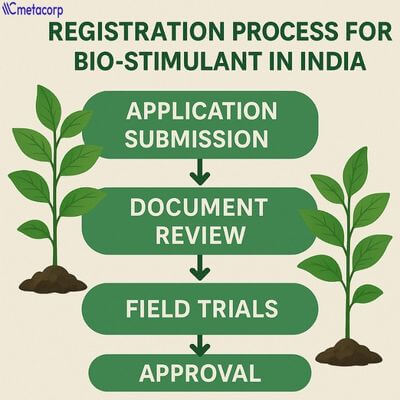
What is the registration Process for Bio stimulants in India
By Team Metacorp
Legal & Compliance Experts
Bio-stimulants are natural or organic substances that help improve plant health, growth, and productivity. They are not fertilizers or pesticides but help plants absorb nutrients better, withstand stress, and grow faster. These can include seaweed extracts, amino acids, vitamins, protein hydrolysates, and plant-based materials.
For manufacturers, importers, or sellers of bio-stimulants in India, government registration is mandatory before legally marketing the product.
Why is Registration Important for Bio stimulants?
1. Legal Requirement under the Fertilizer Control Order (FCO), 1985
The Government of India has made it mandatory for all biostimulant products to be registered under the FCO. The 2021 amendment introduced a structured regulatory framework specifically for biostimulants, which includes mandatory data submission on product composition, toxicity, efficacy, and shelf life. Without proper registration, the manufacture, import, sale, or distribution of biostimulants is strictly prohibited.
2. Ensures Safety, Quality, and Efficacy of the Product
Registration under the FCO ensures that the biostimulant has been thoroughly evaluated for safety to crops, humans, animals, and the environment. It also validates the product’s claimed benefits—such as enhanced nutrient uptake, stress tolerance, and crop productivity—through scientifically backed field trial data. This ensures that only effective and high-quality biostimulants reach the market.
3. Builds Market Trust
Government-registered products inspire confidence among farmers, retailers, and institutional buyers, enhancing credibility and brand reputation.
4. Protects against Legal and Financial Risks
Non-registration can lead to significant legal consequences, including penalties, seizure of stocks, cancellation of licenses, or even product bans. Registration protects your business from such regulatory actions and ensures long-term business continuity. It also minimizes the risk of product recalls, which can damage brand reputation and lead to financial losses.
5. Enables Market Access
Only registered products are eligible for government procurement, institutional sales, and potential exports—expanding business opportunities.
Who Needs to Register?
- Indian manufacturers of bio-stimulants
- Foreign companies looking to import into India
- Distributors selling products under their own brand
- Agro startups or R&D firms launching new plant products
Step-by-Step Registration Process
Step 1: Product Classification
Before you begin, it’s important to determine which category your bio-stimulant falls into. The Government of India has notified specific categories under which bio-stimulants can be registered. These include:
- Botanical extracts
- Bio-chemicals
- Protein hydrolysates
- Amino acids
- Vitamins
- Seaweed extracts
- Other notified natural substances
Step 2: Composition & Labeling Details
You must submit detailed information about your product, including:
- Ingredients and their exact percentage
- Manufacturing process
- Physical and chemical characteristics
- Proposed product label with instructions for use, precautions, dosage, etc.
Step 3: Conducting Bio-efficacy Trials
You need to demonstrate how well your product works in the field by conducting bio-efficacy trials. This must be done through State Agricultural Universities (SAUs) or Indian Council of Agricultural Research (ICAR institutes). The trials are conducted for at least two cropping seasons.
Trial requirements include:
- Selecting 2–3 appropriate crops
- Multiple locations (depending on your target market)
- Monitoring yield improvement, plant health, resistance to stress, etc.
Step 4: Toxicology and Safety Data
Toxicology and eco-toxicology test results are required, particularly if the product contains ingredients that are not commonly recognized or previously registered under the notified bio-stimulant categories. These tests must be conducted at GLP-certified laboratories as per government regulations.
Mandatory tests typically include:
- Acute oral toxicity
- Dermal and eye irritation
- Environmental impact on soil, water, and beneficial insects
Step 5: Chemical Analysis & Heavy Metal Testing
Samples of the biostimulant product must be tested by NABL-accredited laboratories to check for:
- Pesticide residues
- Heavy metal content (lead, arsenic, cadmium, etc.)
- Consistency in nutrient content
- Shelf-life and storage stability
Step 6: Preparation of Dossier
A complete dossier (technical file) is prepared containing:
- Trial reports
- Safety data
- Lab test results
- Manufacturing and formulation details
- Copies of labels and product literature
- This dossier is submitted along with the application for registration.
Step 7: Application Submission
The complete application is submitted both online and physically to the following authorities:
- State Fertilizer Controller (for initial screening)
- Controller of Fertilizers, Ministry of Agriculture (for central evaluation)
- A registration fee must also be paid as per government norms.
Step 8: Evaluation by Central Bio-stimulant Committee
Once submitted, the application is reviewed by the Central Bio-stimulant Committee (CBC) under the Department of Agriculture. This committee includes scientific and regulatory experts who evaluate:
- Whether the product fits the notified category
- Whether the trial results and safety data are satisfactory
- Whether the product is free of harmful substances
Step 9: Gazette Notification & Registration Certificate
Once the application is approved:
- The product name and details are published in the Official Gazette of India
- A Registration Certificate is issued
- The applicant is now authorized to manufacture, import, and sell the biostimulant in India.
Step 10: Post-Registration Compliance
Even after registration, the registrant must comply with certain conditions:
- Report any changes in formulation or source
- Follow labeling and packaging rules strictly
- Maintain records of production and sales
Renew the registration at continuous intervals to avoid cancellaton or penalties.
For more details, please click Here