

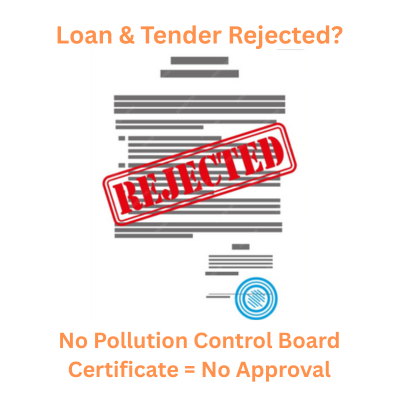
Impact of Not Having a Pollution Control Certificate on Business Loans and Tenders
By Team Metacorp
Legal & Compliance Experts
In today’s regulatory environment, having the right certifications is more than a legal formality—it’s a business necessity. One such crucial document is the Pollution Control Board Certificate, which acts as a green signal that your business complies with environmental norms set by the government. But what happens when a business fails to obtain or renew this certificate?
In this article, we’ll break down the impact of not having a Pollution Control Board Certificate - especially when it comes to applying for business loans and government tenders.
What Is a Pollution Control Board Certificate?
The Pollution Control Board Certificate is issued by State Pollution Control Boards (like GPCB, MPCB, etc.) and serves as proof that your industrial or commercial activity adheres to environmental regulations. This certificate is mandatory for businesses involved in manufacturing, waste generation, chemical usage, or anything that can potentially harm the environment.
Impact on Business Loans
Banks and financial institutions now follow strict compliance checks before approving loans, especially for businesses in the industrial, manufacturing, or chemical sectors. Here’s how the absence of a Pollution Control Board Certificate can affect your chances:
- Loan Rejection Due to Non-Compliance
Most public and private sector banks ask for a copy of the Pollution Control Board Certificate during documentation. Without it, your loan application can be rejected immediately, as the business is considered high-risk and non-compliant.
- Higher Interest Rates or Collateral Requirements
In some cases, even if the loan is approved, banks may impose higher interest rates or ask for more collateral to cover environmental and legal risks.
- Delayed Processing of Loan Applications
Missing compliance documents, especially environment-related ones, can delay the processing time of loans, affecting your working capital and project timelines.
Impact on Government Tenders
Whether you’re bidding for construction contracts, supply of industrial goods, or waste management services—most government tenders require proof of environmental compliance. Here's how a missing Pollution Control Board Certificate can hold you back:
- Disqualification from Tenders
Tender documents often have a clear clause that businesses must have valid environmental clearance. Lack of a Pollution Control Board Certificate can lead to automatic disqualification, regardless of your pricing or experience.
- Negative Reputation in Public Procurement
Once blacklisted or rejected for non-compliance, it becomes difficult to win future tenders as your company gets flagged in government procurement systems.
- Limited Opportunities in Green-Labelled Projects
Many government projects now require bidders to follow sustainability and ESG (Environmental, Social, Governance) standards. Businesses without a Pollution Control Board Certificate are automatically excluded from such opportunities.
How to Get a Pollution Control Board Certificate
To get a Pollution Control Board Certificate, a business must meet the environmental guidelines applicable to its industry. These may vary by state and by the nature of operations. The certificate is issued under two main categories:
- Consent to Establish (CTE) – Required before starting a new unit or expansion
- Consent to Operate (CTO) – Needed to begin commercial operations
You must ensure that your site meets zoning, waste disposal, emission, and safety standards. Inspection and approval by the state pollution control board are mandatory.
How to Apply for a Pollution Control Board Certificate
The application process usually includes:
1. Registering on the SPCB Portal of your respective state (like GPCB, MPCB, HSPCB etc.)
2. Filling out the application form with details about your business activities, machinery, waste generation, etc.
3. Uploading required documents such as layout plans, ownership proof, previous clearances, water/electricity bill, etc.
4. Paying the applicable fee based on your industry size and category (Red, Orange, Green, White)
5. Board Review & Inspection – Authorities may conduct a site visit.
6. Certificate Issuance – If all conditions are met, the board issues the CTE/CTO.
Why You Should Act Now
If your business is operating without a Pollution Control Board Certificate, it’s time to act. Apart from the environmental risk and legal consequences, you're also shutting doors to funding, expansion, and partnerships.
Final Thoughts
The lack of a Pollution Control Board Certificate is more than just a compliance issue—it’s a growth blocker. If you’re looking to expand, raise funds, or win tenders, environmental certification is no longer optional.
To learn more about pollution control board certificate in India, we recommend you to visit Metacorp as it solves legal and compliance issues of new and established businesses.