

India’s Latest Groundwater Quality Report 2026 by the CGWB
By Team Metacorp
Legal & Compliance Experts
Groundwater is the silent lifeline of India’s water system, underpinning nearly every aspect of daily life and economic activity. It supplies about 85% of rural drinking water, nearly 50% of urban water needs, and irrigates close to two-thirds of India’s agricultural land. In a country where monsoon variability, climate change, population growth, and rapid urbanization place increasing stress on surface water resources, groundwater remains the most dependable—yet most vulnerable—source of water security.
Against this backdrop, the Annual Ground Water Quality Report 2025, released by the Central Ground Water Board (CGWB), marks a significant milestone in India’s groundwater governance. It represents one of the most comprehensive, scientifically standardized, and policy-oriented assessments of groundwater quality ever undertaken in the country.
A New Era of Standardized Assessment
A key strength of the 2025 report lies in its adoption of a uniform Standard Operating Procedure (SOP), introduced nationwide in 2023. Prior to this reform, groundwater quality monitoring varied across regions in terms of sampling frequency, analytical parameters, and laboratory practices, limiting comparability. The SOP has harmonized these processes by standardizing:
- Sampling methods and well selection
- Seasonal monitoring protocols (pre-monsoon and post-monsoon)
- Laboratory testing and quality assurance practices
- Data validation and reporting formats
This methodological consistency allows the 2025 report to serve as a credible national baseline, enabling accurate inter-state comparisons and long-term trend analysis
A Nationwide, Standardized Monitoring Framework
For the second consecutive year, the Central Ground Water Board (CGWB) implemented a uniform Standard Operating Procedure (SOP) across India, ensuring consistency in groundwater sampling, laboratory analysis, and data reporting.
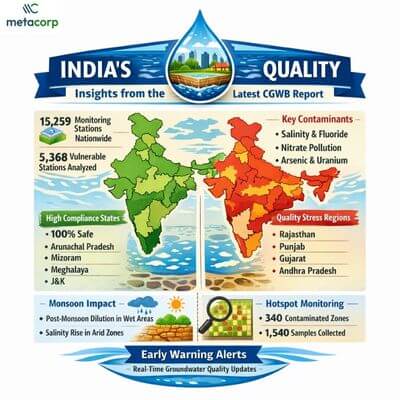
- In 2023, a nationwide network of 15,259 baseline monitoring stations was established, covering diverse hydrogeological and land-use settings. From this network, 5,368 vulnerable stations were identified in 2024 for trend monitoring, with sampling conducted during both pre-monsoon and post-monsoon seasons to capture seasonal and long-term quality changes.
- After data validation and harmonization, 14,978 baseline stations were analyzed to represent the national groundwater quality scenario for 2024–25, making it one of the largest standardized datasets in the country.
- This structured framework enables reliable inter-state comparisons, clear assessment of seasonal recharge impacts, and early detection of emerging groundwater quality risks, strengthening evidence-based policymaking and sustainable groundwater management.
Key Water Quality Parameters Analysis
The CGWB Annual Ground Water Quality Report 2024–25 presents a comprehensive evaluation of groundwater suitability for drinking and irrigation, based on analysis of key physio-chemical and trace elements. All results were assessed against BIS Drinking Water Standards (IS 10500:2012) and standard irrigation criteria.
- Physio-chemical parameters analyzed include pH, Electrical Conductivity (EC), Total Hardness, Calcium, Magnesium, Sodium, Potassium, Chloride, Sulphate, Bicarbonate, Nitrate, Fluoride, and Phosphate. The report notes that while most samples fall within acceptable limits, salinity (high EC), hardness, nitrate, and fluoride exceedances are widespread in arid, semi-arid, and intensively cultivated regions, affecting both drinking water safety and agricultural productivity.
- The assessment also covers trace and toxic elements such as Arsenic, Iron, Manganese, Zinc, Copper, Lead, and Uranium. Iron and manganese are commonly elevated due to geogenic conditions, while arsenic and uranium emerge as region-specific but critical health concerns. Lead exceedances are mainly localized near urban–industrial areas, whereas zinc and copper largely remain within permissible limits.
- Overall, the 2024–25 analysis highlights that groundwater quality challenges in India are highly localized but persistent, reinforcing the need for targeted mitigation, source protection, and continuous, standardized monitoring to ensure long-term drinking water safety and irrigation sustainability.
Regional Variability in Groundwater Quality: A Sharp Contrast across India
The report brings out a pronounced regional disparity in groundwater quality, reflecting the diverse hydrogeological, climatic, and anthropogenic conditions across Indian states.
Regions with High Compliance
States such as Arunachal Pradesh, Mizoram, Meghalaya, and Jammu & Kashmir recorded 100% compliance with BIS drinking water standards. These regions generally benefit from:
- High rainfall and natural recharge, which helps dilute dissolved salts and contaminants
- Low industrial and intensive agricultural activity, reducing anthropogenic pollution loads
- Favorable geology, with hard rock aquifers that are less prone to salinity and toxic element mobilization
As a result, groundwater in these states remains largely suitable for drinking without extensive treatment, apart from basic disinfection.
Regions Facing Quality Stress
In sharp contrast, states including Rajasthan, Haryana, Andhra Pradesh, Gujarat, Punjab, and parts of Uttar Pradesh exhibit frequent exceedances of key water quality parameters, notably:
- High salinity and electrical conductivity, linked to arid climate, over-extraction, and evaporation losses
- Nitrate contamination, primarily from excessive fertilizer use, unregulated sewage disposal, and livestock waste
- Fluoride enrichment, often geogenic in origin but aggravated by groundwater depletion
- Heavy metals (such as arsenic, iron, and uranium), associated with both natural mineral dissolution and industrial or agricultural activities
These contaminants pose serious public health risks, including dental and skeletal fluorosis, kidney damage, and long-term chronic illnesses.
Impact of Monsoon Recharge on Groundwater Quality (2025–26)
- Recent pre- and post-monsoon data shows that monsoon recharge affects groundwater quality in different ways across regions.
- In high-rainfall and permeable aquifer areas, post-monsoon samples generally recorded lower EC and fluoride, mainly due to dilution of dissolved salts from fresh recharge. This improvement is common in shallow alluvial aquifers with limited pollution pressure.
- In contrast, arid and semi-arid regions showed higher EC, fluoride, nitrate, and salinity after monsoon. Rainfall mobilized stored salts, fertilizers, and geogenic contaminants from the unsaturated zone into aquifers, especially in hard-rock terrains and intensively farmed areas.
- Overall, the 2024–25 observations confirm that monsoon recharge does not uniformly improve groundwater quality. Its impact is site-specific, controlled by aquifer characteristics, recharge pathways, and local contamination loads, highlighting the need for seasonal and aquifer-based groundwater management.
Irrigation Suitability: Mostly Safe, with Local Risks
- Groundwater remains largely suitable for irrigation:
- 94.3% of samples fall in the excellent category (SAR < 10).
- 98.9% of samples have SAR ≤ 26, indicating low sodium hazard.
- However, Residual Sodium Carbonate (RSC) exceeded safe limits in 11.27% of samples, particularly in Delhi, Uttarakhand, Andhra Pradesh, Punjab, and Rajasthan, posing risks of soil sodicity.
Hotspot Monitoring: Targeted Surveillance
CGWB identified 340 groundwater quality hotspots where BIS limits were exceeded. Around each hotspot:
- A 2 km × 2 km grid-based sampling was conducted
- 1,540 additional samples were collected
Hotspots were analysed for nitrate, fluoride, arsenic, uranium, EC, and manganese, enabling classification of contamination as localized or multi-directional. This approach provides actionable insights for targeted remediation and source control.
Groundwater Quality Alerts: Early Warning System
Between June 2024 and March 2025, CGWB issued fortnightly groundwater quality alerts to states and central agencies. Alerts flagged exceedances in parameters such as EC, nitrate, fluoride, iron, manganese, arsenic, lead, cadmium, chromium, and uranium.
These alerts act as a real-time early warning mechanism, guiding follow-up sampling, public advisories, and mitigation measures.
Conclusion
The Annual Ground Water Quality Report 2025 marks a significant step forward in India’s groundwater governance. By combining standardized monitoring, hotspot analysis, and real-time alerts, CGWB has created a robust evidence base for policy and action.
The message is clear: India’s groundwater is largely usable, but increasingly vulnerable. Protecting this invisible resource will require sustained monitoring, localised interventions, and strong coordination between governments, communities, and scientific institutions.
Groundwater security is not just an environmental concern—it is a public health, agricultural, and economic imperative for India’s future.