

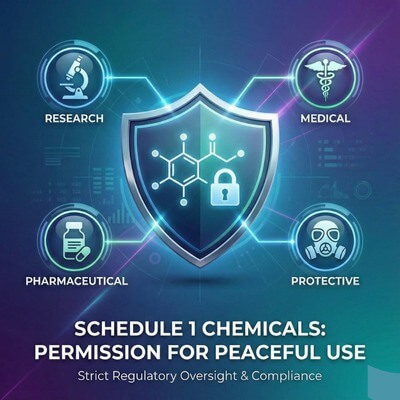
How to produce Schedule 1 Toxic Chemicals or Precursors for research, medical, pharmaceutical and protective purposes
By Team Metacorp
Legal & Compliance Experts
Introduction
- The Chemical Weapons Convention (CWC) is a comprehensive international disarmament treaty that prohibits the development, production, acquisition, stockpiling, transfer, and use of chemical weapons. To prevent misuse, the Convention places the most toxic chemicals and their key precursors under Schedule 1, as they have high toxicity, minimal commercial use, and direct relevance to chemical weapons.
- While these substances are strictly controlled, the CWC permits their limited use for legitimate purposes such as scientific research, medical treatment, pharmaceutical development, and protective activities including detection and defense. Such activities are allowed only within prescribed quantity limits and under strict regulatory supervision.
- Any entity intending to handle Schedule 1 chemicals must obtain prior authorization from the national authority and comply with rigorous requirements, including secure storage, detailed record-keeping, periodic reporting, and inspections. This framework ensures a balance between global chemical disarmament and essential scientific and public safety needs, while maintaining transparency and non-proliferation.
What are Schedule 1 Chemicals?
The Schedule 1 chemicals represent the most tightly controlled substances under the Chemical Weapons Convention (CWC). These chemicals are specifically identified because of their direct association with chemical weapons and their potential to cause severe harm even in very small quantities. Due to these characteristics, their production, possession, and use are subject to the highest level of international and national regulation.
Schedule 1 chemicals include toxic chemical agents and their immediate precursors that meet the following criteria:
- Minimal or no legitimate commercial use: These substances have little or no application outside of chemical weapons programs. Unlike industrial chemicals that have dual-use applications, Schedule 1 chemicals are rarely required for routine manufacturing or trade, making any unauthorized activity highly suspicious.
- Extremely high toxicity and lethality: Even in minute concentrations, Schedule 1 chemicals can cause rapid and severe effects on human health, including death. Their high toxicity makes them particularly dangerous to handle and necessitates specialized facilities, trained personnel, and robust safety controls.
- Direct relevance to chemical weapons: Many Schedule 1 chemicals are either chemical warfare agents themselves or key precursors that can be readily converted into such agents. Because of this direct link, they are considered critical to the verification and enforcement objectives of the CWC.
All Schedule 1 chemicals are explicitly listed in the Annex on Chemicals – Schedule 1 of the CWC, ensuring clarity and uniformity across all State Parties. Activities involving these chemicals are permitted only in strictly limited quantities and solely for approved purposes such as research, medical, pharmaceutical, or protective applications, and only after obtaining authorization from the designated national authority.
Permitted Uses under the Chemical Weapons Convention (CWC)
While the Chemical Weapons Convention imposes an absolute prohibition on the weaponization of Schedule 1 chemicals, it recognizes that a very limited and controlled use of these substances essential for legitimate and peaceful objectives. Accordingly, the CWC permits the production, acquisition, retention, and use of Schedule 1 chemicals only under exceptional circumstances and strictly for the purposes outlined below. All such activities must be pre-authorized by the competent national authority and conducted within prescribed quantitative limits.
1. Research purposes
Schedule 1 chemicals used for bona fide scientific research, including laboratory-scale analytical studies, method development, calibration of instruments, and validation of detection techniques. Such research is typically aimed at enhancing scientific knowledge, improving monitoring capabilities, or supporting regulatory and verification mechanisms, and must be non-commercial in nature.
2. Medical purposes
Limited use is allowed for medical research related to diagnosis, treatment, or understanding the physiological effects of toxic chemical exposure. This includes studies supporting emergency response, toxicology, and the development of medical countermeasures. Clinical or diagnostic use is permitted only where absolutely necessary and under stringent ethical and safety oversight.
3. Pharmaceutical purposes
The Convention permits restricted use for pharmaceutical research and development, such as drug discovery, formulation research, or testing of antidotes and therapeutic agents. These activities must clearly demonstrate peaceful intent and be directly linked to public health objectives, with production volumes kept to the minimum required for research or testing.
4. Protective purposes
Schedule 1 chemicals handled for protective applications, including the development, testing, and validation of detection systems, personal protective equipment, decontamination methods, and antidotes. Such work is essential for preparedness, civil defense, and protection of both civilian populations and authorized personnel against potential chemical threats.
Who Can Apply
- Any person or entity intending to engage in the production, processing, acquisition, consumption, transfer, import, export, or use of any Toxic Chemical or Precursor listed in Schedules 1, 2, or 3 of the Annex on Chemicals to the CWC must apply for prior permission.
- Additionally, any person or entity involved in the production of Discrete Organic Chemicals (DOCs), including DOCs containing phosphorus, sulphur, or fluorine, is also required to seek authorization under the Convention.
Requirement of Government Permission
Any organization intending to produce, acquire, retain, or use Schedule 1 chemicals must obtain prior authorization from the designated national authority.
In India, this authority operates under the framework established to implement the CWC obligations and works in coordination with international oversight bodies.
Permission is mandatory for:
- Manufacturing or synthesis
- Import or export
- Storage or retention
- Consumption or laboratory use
Key Compliance Conditions
Once permission is granted, the entity must comply with strict conditions, including:
- Quantity limits as prescribed under the CWC
- Secure storage and access control
- Detailed record-keeping and inventory management
- Periodic reporting to the national authority
- Acceptance of inspections or audits
- Importance of Regulatory Compliance
The regulation of Schedule 1 chemicals is critical to:
- Prevent chemical weapons proliferation
- Ensure national and global security
- Maintain transparency under international treaties
- Promote responsible scientific and medical research
Conclusion
The permission to produce, acquire, retain, or use Schedule 1 toxic chemicals under the Chemical Weapons Convention is a highly controlled and exceptional allowance, granted only for legitimate research, medical, pharmaceutical, and protective purposes. Strict regulatory oversight ensures that these substances are never diverted for prohibited uses.
For institutions and companies involved in advanced chemical research, early regulatory planning and expert guidance are essential to ensure smooth approval and ongoing compliance.
For more details, please visit Metacorp