

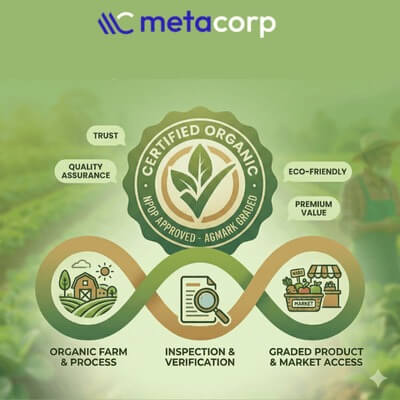
How to get Certification for organic farms & organic agricultural produce
By Team Metacorp
Legal & Compliance Experts
In today’s rapidly evolving agricultural landscape, the demand for safe, authentic, and sustainably produced food has never been higher. As consumers increasingly seek chemical-free and environmentally responsible products, the credibility of the “organic” label becomes critically important. To protect this trust and ensure the highest standards of purity and quality, a formal certification system has been established for organic farms, products, and processes under the Agricultural Produce (Grading and Marking) Act, 1937.
This certification serves as an official assurance that agricultural produce has been cultivated, processed, and handled strictly in accordance with the National Programme for Organic Production (NPOP). It authorizes producers to grade, label, and market their goods as organic while adhering to nationally recognized quality benchmarks. By combining scientific verification with regulatory oversight, the certification framework not only strengthens consumer confidence but also supports India’s growing organic sector in accessing domestic and international markets.
Purpose of Organic Certification
Organic certification is essential for any individual or organization seeking to grade, mark, and market their agricultural produce as “organic.” Under the Agricultural Produce (Grading and Marking) Act, 1937, this certification ensures that:
- Organic farms follow the prescribed production standards.
- Organic products meet the specified quality norms.
- Organic processes maintain integrity and prevent contamination.
- Grading and marking of products adhere to NPOP and AGMARK requirements.
The certification is issued by an accredited Inspection and Certification Agency authorized under NPOP.
Definition of Organic Under NPOP
- The term “organic” refers to a specific farming system as defined under the National Programme for Organic Production and does not relate to the chemical definition of the word.
- The NPOP framework was formally notified by the Director General of Foreign Trade, Ministry of Commerce and Industry, through Notification No. 72(RE-2003)/2002-2007 dated 21st July 2004. These guidelines are periodically revised to align with international standards and emerging agricultural practices.
- A certified organic agricultural produce refers to any agricultural product that has been cultivated and processed strictly in accordance with organic standards and has been formally certified under NPOP rules.
Who Can Apply for Organic Certification?
Any individual, firm, company, cooperative society, trust, or institution may apply for certification if they intend to certify:
- Their organic farm
- Organic agricultural produce
- Organic processing systems
- Grading and marking of organic products
This certification is mandatory for marketing agricultural goods as “organic” under AGMARK and national regulatory laws.
Scope and Components of Organic Certification
Organic certification encompasses a holistic evaluation of cultivation methods, production environments, processing systems, and final outputs. It ensures that every phase of the agricultural value chain meets defined organic criteria.
1. Certification of Organic Farms
Farm certification verifies the implementation of organic principles at the field level. Inspectors evaluate soil fertility management, integrated nutrient and pest management practices, crop rotation strategies, and biodiversity conservation efforts. They also review input records and ensure that no prohibited substances or genetically modified seeds are used. Farms must complete a mandatory conversion period—typically one to three years—to eliminate residual chemicals and establish sustainable organic systems. Regular field inspections, documentation reviews, and laboratory testing form the basis of certification decisions.
2. Certification of Organic Products
Certified organic products must conform to strict quality and traceability requirements. This includes fresh produce such as fruits, vegetables, grains, and pulses, as well as processed items like oils, spices, flours, beverages, and packaged foods. Certification ensures that raw materials are sourced from certified farms and that manufacturing processes prevent contamination or adulteration. Packaging materials, labeling details, and storage conditions are also evaluated to maintain product integrity.
3. Certification of Organic Processes and Handling
Certification extends to all post-harvest and processing operations, ensuring that organic products are handled with utmost care. Processing units must demonstrate complete segregation between organic and non-organic materials, maintain hygienic facilities, use only approved additives, and preserve traceability throughout the production cycle. Transportation, warehousing, and packaging practices must comply with guidelines developed to protect organic purity. Certification bodies conduct routine audits to verify compliance with operational standards.
Documents Required for Organic Certification
Applicants must submit a comprehensive set of documents to demonstrate organizational capability, technical competence, and operational readiness. The required documents include:
Organizational and Personnel Information
- Curriculum Vitae of employees involved in certification activities
- Organization chart showing structure and reporting hierarchy
- CVs of senior members, technical experts, and management personnel
Operational & Institutional Documents
- Documentary evidence of the organization, including registration documents
- Proof of financial status (audited financial statements, turnover details)
- Annual report of the organization
- Number of employees with their bio-data
Authorization Documents
- The application must be signed by the Head of Organisation, Partner, Director, or Managing Trustee
- Documentary proof such as:
-- Power of Attorney
-- Board resolution
-- Authorization letter
These documents verify that the applicant has the legal authority to seek certification and demonstrate compliance readiness.
Certification Procedure
1. Application Submission – Submit the application along with required documents and operational details.
2. Document Review – Certification body reviews historical land use, production systems, and compliance records.
3. On-Site Inspection – Inspectors verify field practices, processing systems, storage, and contamination control measures.
4. Sample Testing – Soil, water, or product samples are tested to confirm the absence of prohibited substances.
5. Conversion Period – A 1–3-year conversion period is followed to ensure compliance with organic farming norms.
6. Final Compliance Evaluation – Follow-up inspections and document audits confirm sustained adherence.
7. Certification Issuance – Upon meeting standards, the certification agency issues the organic certificate.
8. Use of Organic Label – Certified entities use approved organic marks for grading and marketing.
Advantages of Organic Certification
Organic certification provides a wide range of economic, environmental, and social benefits. Producers gain enhanced access to high-value markets, receive better price premiums, and build strong brand credibility. Consumers benefit from reliable assurance of product safety, purity, and traceability. From an environmental perspective, certification promotes farming practices that improve soil fertility, reduce chemical pollution, conserve biodiversity, and support ecological balance. For the organic sector as a whole, certification strengthens transparency, reduces fraudulent claims, and upholds the long-term sustainability of the organic agriculture ecosystem.
Conclusion
Organic certification under the Agricultural Produce (Grading and Marking) Act, 1937 plays a crucial role in maintaining the transparency, reliability, and market value of organic products in India. By adhering to the National Programme for Organic Production and its rigorous standards, producers can ensure that their organic claims are authentic, verifiable, and aligned with national and international quality benchmarks.
The certification strengthens consumer trust, enhances market access, and ensures that the organic farming ecosystem operates with integrity and accountability.
For more details, please visit Metacorp